
ChatGPT Business Profiles: What They Mean for Local SEO
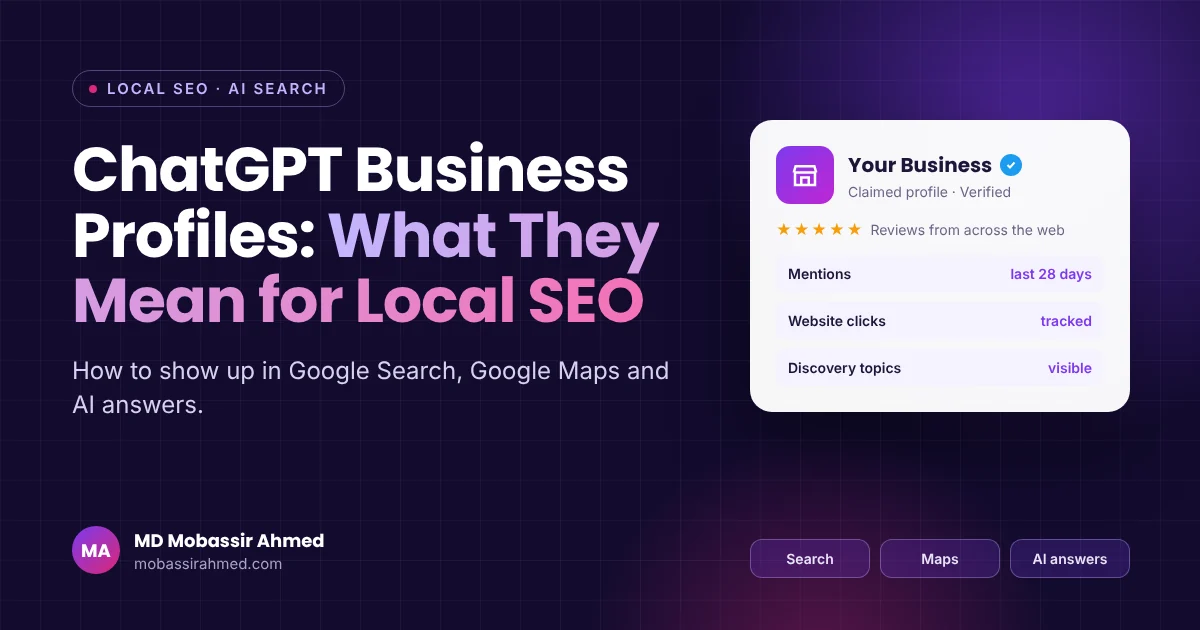
Your customers now find you in Google Search, Google Maps and AI answers. Here’s how to show up in all three.
Quick answer: ChatGPT business profiles let a business claim its listing inside ChatGPT, correct its details and see how often ChatGPT mentions it. OpenAI opened the beta on November 10, 2026 (VentureBeat).
For local SEO, the change is simple to state. Google is no longer the only place customers decide who to call. A claimed profile helps ChatGPT describe you correctly, but it does not decide whether ChatGPT recommends you. That still depends on your website, your Google Business Profile, your reviews and what other sites say about you.
This guide explains what launched, why Google-only SEO now leaves gaps, and how to build one system that works across Search, Maps and AI.
Table of Contents
What are ChatGPT business profiles?
A ChatGPT business profile is the official, owner-managed version of your business inside ChatGPT. OpenAI calls the program Businesses in ChatGPT and runs it through a dashboard called Business Hub.
How claiming works
- Find your business in Business Hub, signed in with a work account.
- Verify the claim through a business phone, business email, DNS record on your domain or a Shopify login.
- Pass an identity check through Persona. This can ask for a government ID, business registration details and proof that you are authorized (eesel AI).
- Edit your profile: website, description, category, logo, photos, hours and policies. OpenAI reviews edits before they publish.
Once approved, you get a blue check and a dashboard showing 28 days of mentions, website clicks and “discovery topics.” For a local business, a mention counts each time ChatGPT shows your location in an answer, even without a click. It is free at launch.
The limits that matter for local businesses
- Local stores and restaurants can claim only an existing U.S. listing. They can’t add a missing one.
- Claiming a brand does not claim its locations, and multi-location brands can’t be managed centrally yet.
- OpenAI says claiming doesn’t guarantee more visibility or control over ChatGPT’s recommendations, and ChatGPT may still use other sources about you.
My professional view: treat the profile as a way to correct how ChatGPT describes you, not as a ranking lever. The ranking work happens everywhere else.
Why Google-only SEO is no longer enough
The old SEO scoreboard had one line on it: your target keyword and your Google position. Number one meant you’d won.
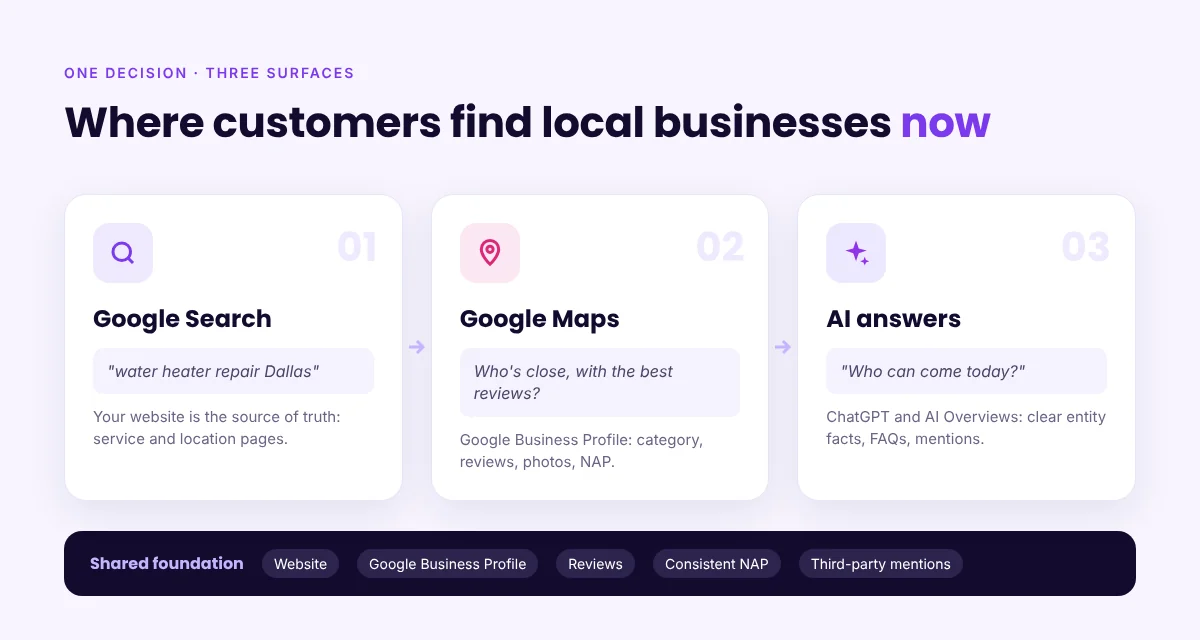
Now follow a homeowner in Dallas whose water heater just failed.
- She searches “water heater repair Dallas” and skims the top results.
- She switches to Google Maps to see who is close and who has the best reviews.
- Before calling, she asks ChatGPT: “Which water heater repair companies in Dallas can come today?”
She used three surfaces to make one decision. A business ranking first on Google but missing from the Map Pack, or described wrongly by ChatGPT, can still lose that call.
That’s the real shift. Search engines, maps and AI assistants all draw from overlapping sources, so a weak spot on one now leaks into the others.
Surface 1: Google Search (your website is the source of truth)
Why it matters: your website is the only channel you fully own. Google reads it to rank you, Google Maps links to it, and AI tools quote it.
Service pages
Give each core service its own page. A page titled “Services” that lists ten things in one paragraph tells Google, and AI, very little. A dedicated “Emergency water heater repair in Dallas” page answers a specific question.
On each page, cover what the service is, who it is for, a price range if you can share one, how long it takes, and what the customer should do next.
Location pages
If you serve several cities or neighborhoods, build a page for each one you genuinely serve. Fill it with local substance: local regulations, typical problems in that area, photos of real jobs there. Pages that only swap the city name are thin content and rarely earn rankings or trust.
Technical health
- Pages are crawlable, indexed and load quickly on mobile.
- Each page has a clear title and one main topic.
- LocalBusiness structured data matches the name, address, phone and hours shown on the page.
This same work feeds AI search. Google states that AI Overviews and AI Mode have no extra requirements beyond normal Search eligibility and good SEO practice (Google Search Central).
Surface 2: Google Maps (where local calls happen)
Why it matters: for most service businesses, the call button on the Google Business Profile drives more leads than the website. Google ranks local results on relevance, distance and prominence (Google Business Profile Help). Distance is fixed, so focus on the other two.
- Primary category. Choose the most specific one that is accurate. “Personal injury attorney” and “Lawyer” compete in different searches. Add secondary categories only for services you really offer.
- Reviews. Google lists review count and rating as part of prominence. Build a simple habit of asking every satisfied customer, and reply to every review within a few days.
- Photos. Real images of your team, premises, vehicles and finished work. Update them regularly.
- NAP consistency. Your name, address and phone number should match character for character on Google, your website, Yelp, Bing Places, Apple Business Connect and industry directories.
In healthcare and legal, the industry directories carry extra weight. Keep Healthgrades, Zocdoc, Avvo or Justia listings in line with your Google profile.
Surface 3: AI answers (ChatGPT and Google AI Overviews)
How do AI tools choose which businesses to mention? They assemble answers from many sources at once rather than from one ranked list.
For ChatGPT, some of those sources are public:
- OpenAI licensed Yelp’s reviews, ratings, photos and business details for local answers (PinMeTo).
- ChatGPT’s local business panels combine details from several data providers, business websites and third-party sites (Near Media).
- Your claimed business profile now adds your own verified input.
In my experience, three things make a business easier for AI systems to understand and cite:
1. Clear entity information
Write one plain sentence that says who you are, what you do, where and for whom. Use it on your homepage, About page, Google profile and directory listings. For example: “Greenway Plumbing is a licensed plumber in Dallas, Texas, offering same-day water heater and drain repair.”
2. FAQs that answer real questions
AI answers are built from short, direct passages. Add FAQs that cover what customers actually ask: price ranges, service areas, hours, insurance or payment options, response times. Answer first, then explain.
3. Third-party mentions
AI systems weigh what others say about you: reviews on Google and Yelp, industry directories, local news, chambers of commerce, associations and partner websites. One accurate mention on a trusted local site can do more than ten pages of self-description.
No one can guarantee a place in ChatGPT or AI Overviews. What you can do is make sure every source an AI checks tells the same, accurate story.
One system, not three
The good news: you don’t need three separate strategies. Most local SEO work helps every surface at once.
| Shared input | Google Search | Google Maps | AI answers |
|---|---|---|---|
| Service and location pages | Main ranking content | Supports relevance via your website link | Main source for what you offer |
| Google Business Profile | Appears in local and branded results | Core ranking asset | Feeds Google’s AI features |
| ChatGPT business profile | No direct effect | No direct effect | Corrects how ChatGPT describes you |
| Consistent name, address, phone | Builds trust | Supports ranking | Removes conflicting facts |
| Reviews on Google and Yelp | Shown in some results | Core prominence signal | Yelp data is licensed by ChatGPT |
| FAQs on your website | Long-tail visibility | Indirect | Quotable answers |
| Third-party mentions | Links and authority | Prominence | Independent proof |
| LocalBusiness structured data | Rich result eligibility | Indirect | Clearer business facts |
The principle behind the table: get your facts right once, then repeat them everywhere.
A 5-point self-check you can do today
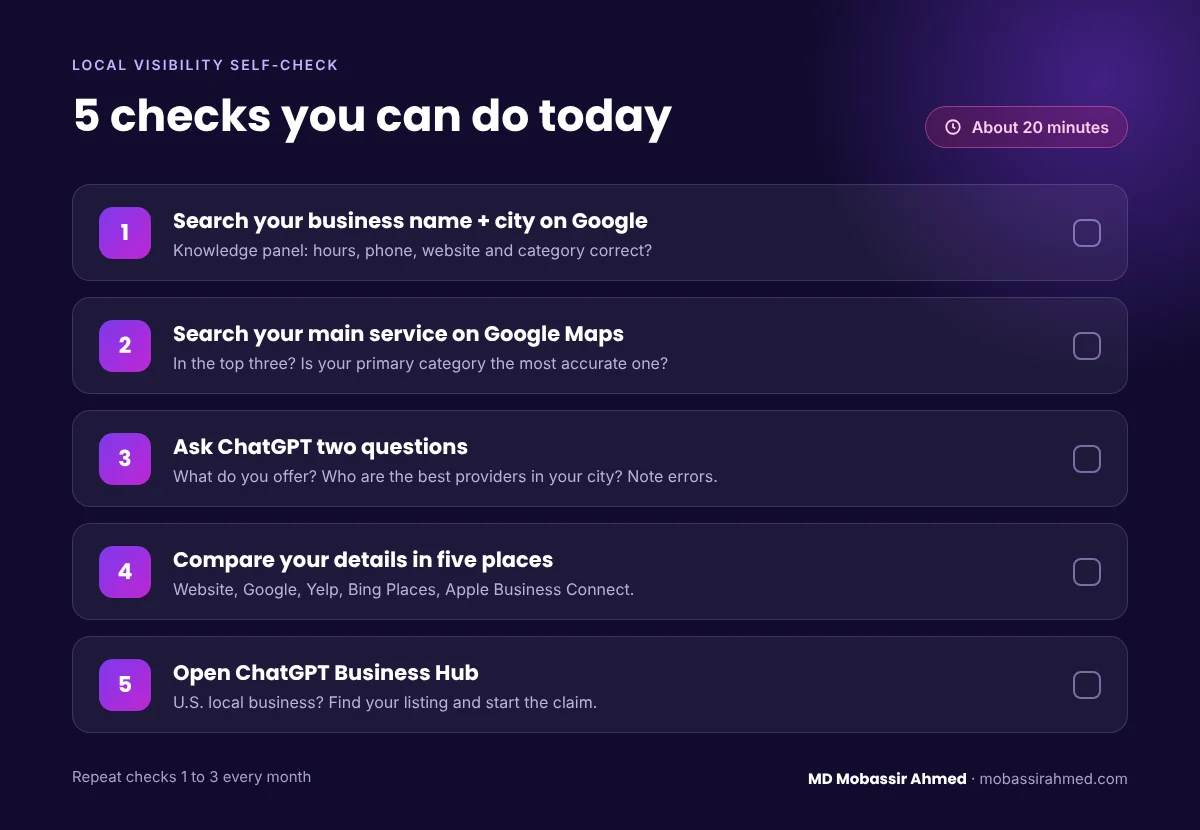
Set aside 20 minutes. You need only a browser and a notepad.
- Search your business name and city on Google. Check that the knowledge panel shows the right hours, phone, website and category.
- Search your main service on Google Maps. Note whether you appear in the top three, and whether your primary category is the most accurate one.
- Ask ChatGPT two questions. “What does [business name] in [city] offer?” and “Who are the best [service] providers in [city]?” Write down anything it gets wrong and whether you’re named.
- Compare your details in five places. Website, Google, Yelp, Bing Places and Apple Business Connect. Fix any difference in name, address, phone or hours.
- Open ChatGPT Business Hub. If you are a U.S. local business, find your listing and start the claim. If you sell online, check whether your market is supported.
Repeat steps 1 to 3 every month. It is the simplest way to track your visibility across all three surfaces.
When it’s worth getting help
Many businesses can handle the self-check alone. Outside help makes sense when:
- You have several locations and the details differ from listing to listing.
- You work in a regulated field like healthcare or law, where directories, categories and wording carry extra weight.
- You rank on Google but don’t appear in the Map Pack, or ChatGPT describes you wrongly and you can’t find the source.
- You simply don’t have time to keep every listing current.
I help local businesses with local SEO, Google Business Profile optimization and AI search visibility (GEO/AEO). If your self-check turned up gaps, get in touch for an audit of how you show up across Google Search, Google Maps and ChatGPT.
Frequently asked questions
How do I claim my business on ChatGPT?
Sign in to Business Hub with a work account, search for your business and start the claim. OpenAI verifies it by phone, email, DNS record or Shopify, then asks the manager to pass a Persona identity check.
Does a ChatGPT business profile cost anything?
No, it is free at launch. OpenAI has not ruled out paid features later.
Will claiming my profile help me rank in ChatGPT?
Not directly. OpenAI says claiming doesn’t guarantee more visibility or control over its recommendations. It helps ChatGPT show accurate details about your business.
Can businesses outside the U.S. claim a ChatGPT profile?
Online businesses can apply in markets where ChatGPT operates and verification is supported. Local store and restaurant claims are currently limited to existing U.S. listings.
Is ChatGPT replacing Google Business Profile?
No. Google Maps remains where most local calls and direction requests begin. ChatGPT is an extra channel built on many of the same signals.
What is GEO, and is it different from local SEO?
GEO (generative engine optimization) means making your business easy for AI tools to understand and cite. It rests on the same foundation as local SEO, with extra focus on clear facts, quotable answers and third-party mentions.
What comes next
This is part 1 of a 15-part series on local SEO across Google Search, Google Maps and AI answers. The next parts go deeper into each surface, step by step.

Written by
Mobassir Ahmed
MD Mobassir Ahmed is a local SEO and Google Business Profile specialist with about 5 years in SEO and 100+ projects. He helps local businesses, healthcare practices and law firms get found across Google Search, Google Maps and AI answers (GEO/AEO).
Free local SEO audit
Want to show up in Google Search, Google Maps and AI answers?
Get a clear audit of where your business is visible, where it is missing, and what to fix first.
